Home | Projects | Notes > Data Structures & Algorithms > Doubly-Linked Lists
Doubly-Linked Lists
Introduction
A doubly linked list is a linear data structure where each node contains a data value, a pointer to the next node, and a pointer to the previous node. This bidirectional linkage allows traversal in both forward and backward directions. It is particularly useful when two-way navigation or efficient deletion from both ends is required.
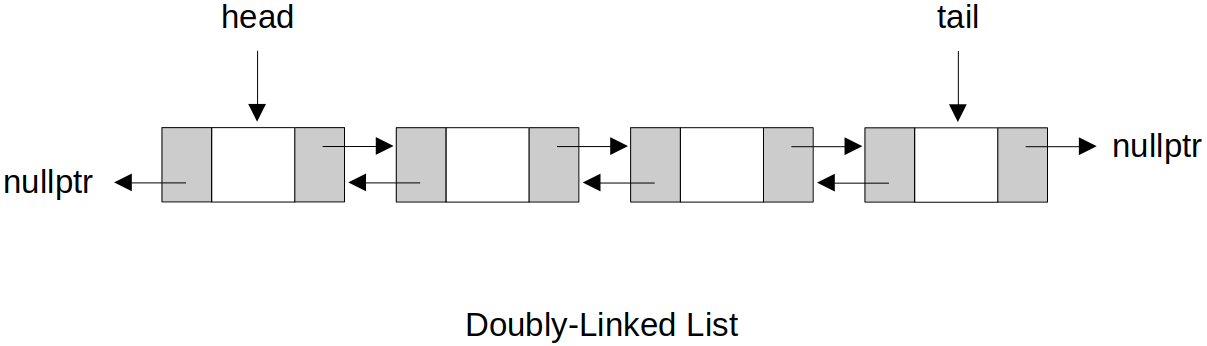
Pros:
Bidirectional Traversal: Can move both forward and backward through the list.
Efficient Insertions/Deletions:
O(1)insertion or removal from both ends or given nodes (with pointer access).Flexible Memory Usage: Dynamically grows and shrinks at runtime.
Cons:
Higher Memory Overhead: Each node stores two pointers (
nextandprev), doubling pointer storage compared to a singly linked list.More Complex Management: Insertions and deletions require careful pointer updates in both directions.
Less Cache-Friendly: Like singly linked lists, nodes are non-contiguous in memory.
Compared to Singly-Linked Lists:
Better: Easier to delete nodes from the middle, supports reverse traversal.
Worse: Slightly more memory usage and pointer management complexity.
Implementation (C++)
Header (dlist.hpp)
461//==============================================================================2// File : doubly_linked_list.h3// Brief : Interface for Doubly-Linked List4// Author : Kyungjae Lee5// Date : May 17, 20236//==============================================================================7
8
11// Class for list nodes12class Node13{14public:15 int value;16 Node *next;17 Node *prev;18
19 Node(int value); // Constructor20};21
22// Class for doubly-linked lists23class DoublyLinkedList24{25public: 26 // Public interface27 DoublyLinkedList(int value); // Constructor28 void append(int value); // Add a node at the end29 void prepend(int value); // Add a node at the front30 bool insert(int index, int value); // Insert a node into the given index position31 void deleteNode(int index); // Delete a node with the given index position32 void deleteLast(); // Delete the last node33 void deleteFirst(); // Delete the first node34 Node* get(int index); // Get the node value of the given index position35 bool set(int index, int value); // Set the node value of the given index position36 void reverse(); // Reverse the list37 void printList(); // Print the list38 ~DoublyLinkedList(); // Destructor39
40private:41 Node *head;42 Node *tail;43 int length;44};45
46// DOUBLY_LINKED_LIST_HSource (dlist.cpp)
3161//==============================================================================2// File : doubly_linked_list.h3// Brief : Implementation of Doubly-Linked List4// Author : Kyungjae Lee5// Date : May 17, 20236//==============================================================================7
8// EXIT_FAILURE10
12using namespace std;13
14//------------------------------------------------------------------------------15// Implementation of Node class interface16//------------------------------------------------------------------------------17
18// Constructor19Node::Node(int value)20{21 this->value = value;22 next = nullptr;23 prev = nullptr;24}25
26//------------------------------------------------------------------------------27// Implementation of DoublyLinkedList class interface28//------------------------------------------------------------------------------29
30// Constructor31// T = O(1)32DoublyLinkedList::DoublyLinkedList(int value)33{34 Node *newNode = new Node(value);35 head = newNode;36 tail = newNode;37 length = 1;38}39
40// Add a node at the end41// T = O(1)42void DoublyLinkedList::append(int value) 43{44 Node *newNode = new Node(value);45
46 // Insert a node into an empty list47 if (length == 0) // (head == nullptr) or (tail == nullptr)48 { 49 head = newNode;50 tail = newNode;51 } 52 // Insert a node into a non-empty list53 else54 { 55 tail->next = newNode;56 newNode->prev = tail;57 tail = newNode;58 } 59
60 length++;61}62
63// Add a node at the front64// T = O(1)65void DoublyLinkedList::prepend(int value)66{67 Node *newNode = new Node(value);68
69 // Insert a node into an empty list70 if (length == 0)71 {72 head = newNode;73 tail = newNode;74 }75 // Insert a node into a non-empty list76 else77 {78 newNode->next = head;79 head->prev = newNode;80 head = newNode;81 }82
83 length++;84}85
86// Insert a node into the given index position87// T = O(n)88bool DoublyLinkedList::insert(int index, int value)89{90 // Validity check for index91 if (index < 0 || index > length)92 return false;93
94 // Insert a node at front (prepend)95 if (index == 0)96 {97 prepend(value);98 return true;99 }100
101 // Insert a node at the end (append)102 if (index == length)103 {104 append(value);105 return true;106 }107
108 // Insert a node somewhere in the middle109 Node *newNode = new Node(value);110 Node *before = get(index - 1);111 Node *after = before->next;112 newNode->prev = before;113 newNode->next = after;114 before->next = newNode;115 after->prev = newNode;116
117 length++;118
119 return true;120}121
122// Delete a node with the given index position123// T = O(n)124void DoublyLinkedList::deleteNode(int index)125{126 // Validity check for index127 if (index < 0 || index >= length)128 return;129
130 // Delete the first node131 if (index == 0)132 return deleteFirst(); // Available only when return types are the same133
134 // Delete the last node135 if (index == length - 1)136 return deleteLast();137
138 // Delete the node from somewhere in the middle139 Node *delNode = get(index);140 delNode->prev->next = delNode->next;141 delNode->next->prev = delNode->prev;142 delete delNode;143
144 length--;145}146
147// Delete the last node148// T = O(1)149void DoublyLinkedList::deleteLast()150{151 // Do not allow delete operation on an empty list152 if (length == 0)153 {154 cout << "ERROR: Cannot delete from an empty list. Terminating!" << endl;155 exit(EXIT_FAILURE);156 }157
158 Node *delNode = tail;159
160 // If only 1 node in the list161 if (length == 1)162 {163 head = nullptr;164 tail = nullptr;165 }166 // If 2+ nodes in the list167 else168 {169 tail = tail->prev;170 tail->next = nullptr;171 }172
173 delete delNode;174
175 length--;176}177
178// Delete the first node179// T = O(1)180void DoublyLinkedList::deleteFirst()181{182 // Do not allow delete operation on an empty list183 if (length == 0)184 {185 cout << "ERROR: Cannot delete from an empty list. Terminating!" << endl;186 exit(EXIT_FAILURE);187 }188
189 Node *delNode = head;190
191 // If only 1 node in the list192 if (length == 1)193 {194 head = nullptr;195 tail = nullptr;196 }197 // If 2+ nodes in the list198 else199 {200 head = head->next;201 head->prev = nullptr;202 }203
204 delete delNode;205
206 length--;207}208
209// Get the node value of the given index position210// T = O(n)211Node* DoublyLinkedList::get(int index)212{213 // Validity check for index214 if (index < 0 || index >= length)215 return nullptr;216
217 Node *temp = head;218
219 // Search for the node220
221 /* This would still work, but optimization can be done!222 for (int i = 0; i < index; i++)223 temp = temp->next;224 */225
226 // If the index is within the first half of the list227 if (index < length / 2)228 {229 // Start searching from the head230 for (int i = 0; i < index; i++)231 temp = temp->next;232 }233 // If the index is within the second half of the list234 else235 {236 // Start searching from the tail237 temp = tail;238 for (int i = length - 1; i > index; i--)239 temp = temp->prev;240 }241
242 return temp;243}244
245// Set the node value of the given index position246// T = O(n)247bool DoublyLinkedList::set(int index, int value)248{249 // Get the node250 Node *temp = get(index);251
252 // Set the value253 if (temp)254 {255 temp->value = value;256 return true;257 }258
259 return false;260}261
262// Reverse the list263// T = O(n)264void DoublyLinkedList::reverse()265{266 // Swap head and tail267 Node *curr = head;268 head = tail;269 tail = curr;270
271 Node *temp = nullptr; // Temporary pointer to be used for swaping prev & next pointers272
273 // Iteratively swap prev and next pointers274 while (curr)275 { 276 // Swap prev and next277 temp = curr->prev;278 curr->prev = curr->next;279 curr->next = temp;280
281 // Advance curr282 curr = curr->prev;283 } 284}285
286// Print the list287// T = O(n)288void DoublyLinkedList::printList()289{290 Node *temp = head;291
292 while (temp)293 {294 cout << temp->value << " ";295 temp = temp->next;296 }297
298 cout << endl;299}300
301// Destructor302// T = O(n)303DoublyLinkedList::~DoublyLinkedList()304{305 // head, tail, length will be destroyed by default, but the nodes will not.306 // So, make sure to delete them manually in the destructor.307
308 Node *temp = head;309
310 while (head)311 {312 head = head->next;313 delete temp;314 temp = head;315 }316}Test Driver
571//==============================================================================2// File : main.cpp3// Brief : Test driver for Doubly-Linked List4// Author : Kyungjae Lee5// Date : May 17, 20236//==============================================================================7
8
11using namespace std;12
13int main(int argc, char *argv[])14{15 // Create a doubly-linked list16 DoublyLinkedList *dll = new DoublyLinkedList(2);17 18 // Prepend19 dll->prepend(1);20
21 // Append22 dll->append(4);23 dll->append(5);24 dll->append(6);25
26 // Insert (insert 3 at index 2)27 dll->insert(2, 3); 28
29 // Print the list30 dll->printList(); // 1 2 3 4 5 631
32 // Delete first33 dll->deleteFirst();34
35 // Delete last36 dll->deleteLast();37
38 // Delete from the middle (index 1)39 dll->deleteNode(1);40
41 // Print the list42 dll->printList(); // 2 4 543
44 // Set (value of the node at index 1 to 10)45 dll->set(1, 10);46
47 // Get (value of the node at index 1 to 10)48 cout << dll->get(1)->value << endl; // 1049
50 // Reverse the list51 dll->reverse();52
53 // Print the list54 dll->printList(); // 5 10 255
56 return 0;57}411 2 3 4 5 6 22 4 5 31045 10 2